Start your first month free! Get 5,000 credits to put ZIP to work.
Sign up free
The Hidden ROI of AI SDRs: Beyond Lead Volume (Time Saved, Data Quality, Pipeline Predictability)
Discover the hidden ROI of AI SDRs beyond lead volume, including time saved, better CRM data, faster follow-ups, improved pipeline visibility, and predictable revenue.
Ramya S.
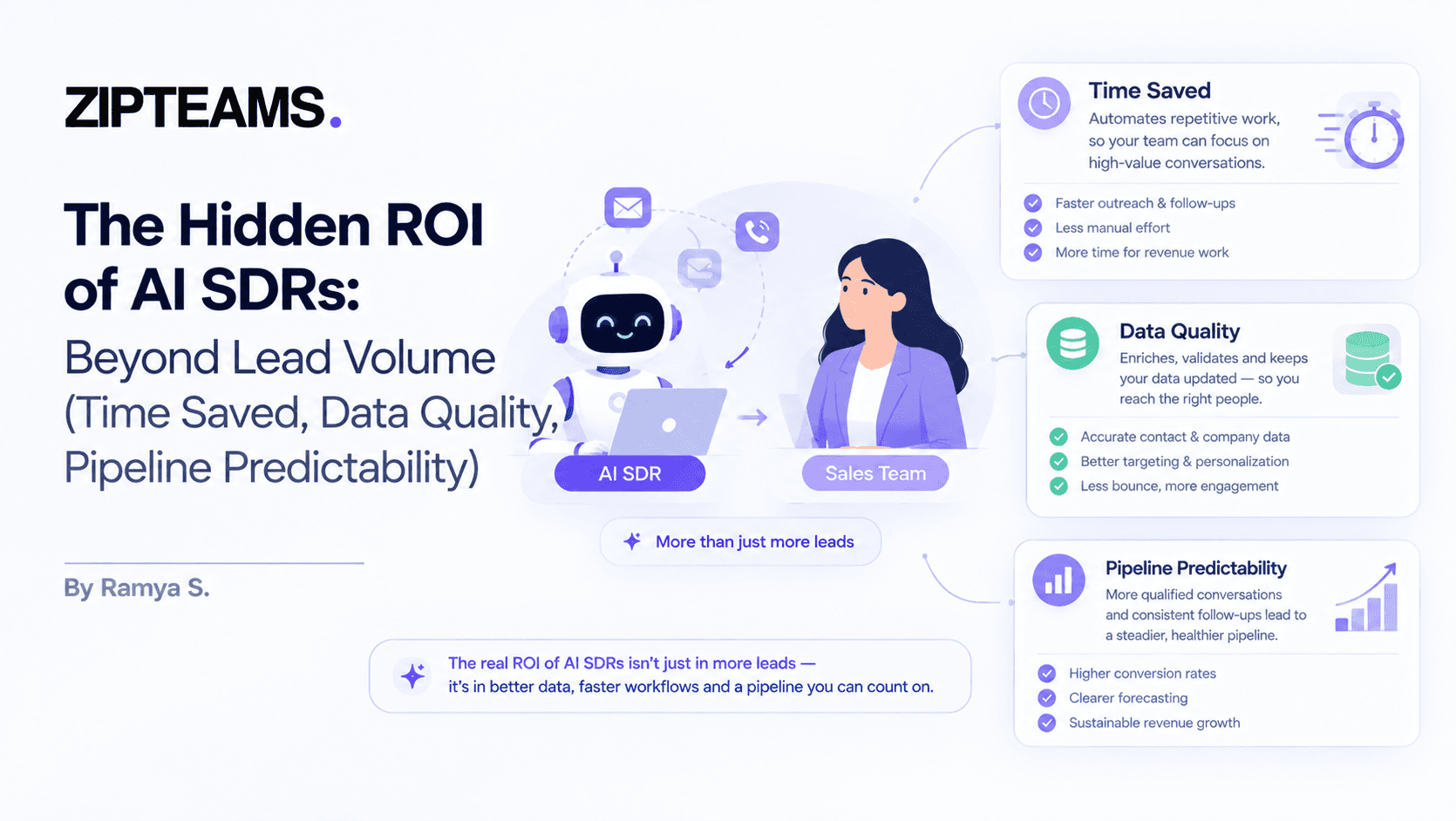
When businesses evaluate an AI SDR, the first questions are usually straightforward.
How many leads can it contact? How many conversations can it start? How many meetings can it book?
These metrics matter, but they tell only part of the story.
An AI SDR can increase outreach volume without improving the quality of conversations. It can book more meetings without increasing qualified opportunities. It can automate follow-ups while leaving the CRM full of incomplete or outdated information.
In these cases, activity increases, but the underlying sales process may not improve.
The more meaningful return on investment (ROI) often comes from changes that are less visible at first:
Sales reps spend less time on repetitive administrative work.
Lead records contain more complete and useful information.
Follow-ups happen at the right time and reflect previous conversations.
Sales teams spend more time on opportunities that fit their priorities.
Managers gain a clearer picture of pipeline quality and future performance.
These benefits can compound. Better information improves qualification. Better qualification improves prioritization. Better prioritization helps sales reps use their time more effectively. And more consistent execution gives revenue teams a stronger basis for forecasting.
The hidden ROI of AI SDRs is the value created by making the entire sales process more efficient, informed, and consistent—not simply by increasing lead volume.
This guide explains how to identify, measure, and calculate that value.
What Is the ROI of an AI SDR?
AI SDR ROI measures the financial and operational value an AI sales development representative generates relative to the cost of implementing and operating it.
A basic ROI calculation is:
[
\text{ROI}=\frac{\text{Benefits}-\text{Costs}}{\text{Costs}}\times100
]
Benefits can include incremental gross profit, reduced operating expenses, and measurable productivity gains. Costs can include software, implementation, integrations, monitoring, and human oversight.
However, not every benefit should be counted as immediate financial savings.
For example, if an AI SDR saves a sales rep five hours per week, the business has gained capacity. It has not necessarily reduced payroll costs by the equivalent amount.
The financial value depends on what the team does with that time.
If the rep uses it to conduct more qualified discovery calls, follow up with high-intent buyers, or progress existing opportunities, the time savings can contribute to revenue.
A useful way to evaluate AI SDR ROI is to separate it into five categories:
Time and productivity: Less manual work per lead.
Data quality: More complete, accurate, and actionable customer records.
Pipeline quality: Better qualification and prioritization.
Execution consistency: More reliable follow-ups and fewer missed opportunities.
Pipeline predictability: Better visibility into lead progression and conversion patterns.
Each category needs its own measurement approach. Together, they provide a more complete picture than lead volume alone.
1. Time Saved: The Productivity Gains Hidden Inside the Sales Process
Sales representatives spend time on much more than selling.
They review lead records, search for previous interactions, write follow-up messages, update CRM fields, schedule reminders, and determine which prospects to contact next.
Some of this work is necessary. Much of it is repetitive.
An AI SDR can automate or assist with several of these tasks, freeing salespeople to focus on activities that require human judgment.
Where sales teams lose time
Consider the workflow of an inbound sales representative.
A new lead arrives. The rep checks the CRM, reviews the lead source, looks for previous conversations, attempts contact, records the outcome, and schedules a follow-up if the prospect doesn't respond.
If the prospect replies later, the rep must recover the context and continue the conversation.
Multiply that workflow across hundreds or thousands of leads, and the administrative burden becomes substantial.
The time cost isn't just the minutes spent on each task. It's also the interruption caused by switching between tools and reconstructing context.
An AI SDR can help reduce that burden by:
Initiating approved outreach.
Asking qualification questions.
Capturing responses.
Updating supported CRM fields.
Recording conversation summaries.
Scheduling follow-ups.
Identifying relevant buying signals.
Preparing context for sales reps.
Creating tasks based on conversation outcomes.
The greatest benefit often comes when these activities work together rather than operating as disconnected automations.
Calculate the value of time saved
Start by identifying which tasks the AI SDR actually removes or shortens.
For each task, measure the time spent before and after implementation.
A practical formula is:
[
\text{Hours Saved}=\frac{N\times(T_b-T_a)}{60}
]
Where:
(N) = number of tasks completed.
(T_b) = average baseline minutes per task.
(T_a) = average minutes remaining after automation.
For example, suppose a team handles 1,000 lead interactions each month.
Before automation, the team spends an average of six minutes per interaction on administrative and follow-up work. After implementation, that work takes two minutes per interaction because the AI handles part of the workflow.
The illustrative time savings are:
[
\frac{1{,}000\times(6-2)}{60}
=66.7\text{ hours}
]
That's approximately 67 hours of capacity recovered per month.
These numbers are an example, not an industry benchmark. Your actual savings will depend on lead volume, workflow complexity, automation coverage, and the amount of human review required.
Time saved is only the beginning
The next question is what happens to the recovered capacity.
There are three possible outcomes:
Capacity gain: Reps can handle more work without additional headcount.
Revenue gain: Reps spend more time on qualified conversations and opportunities.
Cost reduction: The business can reduce specific operating expenses.
These outcomes are related, but they are not interchangeable.
If the sales team has no additional qualified opportunities to work on, recovered time may not create immediate revenue. If the team has a large backlog of high-intent leads, however, that capacity could be extremely valuable.
What to measure: Administrative minutes per lead, CRM update time, follow-up preparation time, productive selling hours, and leads handled per rep.
2. Data Quality: Turning Conversations Into Usable Sales Intelligence
A CRM can contain thousands of records and still provide an incomplete picture of the buyer.
A lead may have a name, company, phone number, and email address, but lack the information that helps a salesperson decide what to do next.
For example:
What problem is the prospect trying to solve?
Which product or service are they interested in?
What is their expected timeline?
What requirements matter most?
What objections have they raised?
Why did they stop responding?
What happened during the last conversation?
When these details are missing, sales reps must ask the same questions again or make decisions based on assumptions.
An AI SDR can improve data quality by capturing relevant information during conversations and updating the appropriate fields in connected systems.
From unstructured conversations to structured data
Imagine a prospect says:
“We're looking for a solution for our 20-person sales team. We currently follow up manually, and we'd like to get something running before the next quarter. It also needs to work with our CRM.”
A basic CRM record might contain only the lead's contact details.
A well-designed AI SDR workflow could capture:
Team size: 20 salespeople
Current process: Manual follow-ups
Primary need: Follow-up automation
Timeline: Before next quarter
Integration requirement: Existing CRM
Next action: Discuss integration and implementation
This transforms a conversation into information that can be used for qualification, routing, personalization, and reporting.
The AI should only populate fields supported by the conversation or trusted source data. If the prospect hasn't provided a budget, for example, the system shouldn't invent one.
Better data reduces downstream friction
Data quality creates value at multiple stages.
For sales reps: They can prepare for conversations without reconstructing the prospect's history.
For sales managers: They can understand why leads are progressing or stalling.
For marketing teams: They can identify which sources and campaigns produce leads that match the ideal customer profile.
For operations teams: They can improve routing, reporting, segmentation, and workflow automation.
For AI workflows: Future interactions can use previous context instead of treating every conversation as a fresh start.
This last point is particularly important.
If the AI SDR remembers what the prospect said previously, it can avoid repeating questions, tailor follow-ups, and recognize changes in buying intent.
How to measure CRM data quality improvements
Track data quality before and after introducing the AI SDR.
Useful measures include:
Percentage of records with required fields completed.
Percentage of conversations accurately reflected in the CRM.
Frequency of duplicate or conflicting records.
Percentage of records with a documented next step.
Number of manual corrections made by sales reps.
Accuracy of captured qualification details.
Percentage of records with up-to-date interaction history.
Don't optimize for field completion alone.
A CRM field filled with an incorrect value is worse than an empty field because it can mislead routing, reporting, and sales decisions.
The goal is accurate, useful, and current data, not simply more data.
3. Better Qualification: Less Time Spent on the Wrong Leads
Not every lead deserves the same amount of sales attention.
Some prospects are a strong fit, have a clear business need, and are ready to evaluate a solution. Others are researching, lack a relevant use case, or don't match the company's target customer profile.
When qualification is inconsistent, sales reps can spend valuable time on low-fit or low-intent prospects while stronger opportunities wait.
An AI SDR can apply consistent qualification criteria across conversations and help sales teams prioritize leads based on the evidence collected.
Qualification goes beyond a score
A single lead score can hide important differences between prospects.
Consider these two leads:
Lead A
Matches the target customer profile.
Has a relevant use case.
Wants to implement within 30 days.
Has requested a product demonstration.
Lead B
Matches the target customer profile.
Is researching solutions.
Has no defined implementation timeline.
Has not requested a sales conversation.
Both might receive similar demographic fit scores, but their immediate sales priorities should differ.
A useful qualification framework separates:
Fit: Does the prospect match the target customer profile?
Need: Is there a relevant problem to solve?
Intent: Are there meaningful signs of active evaluation?
Timing: When does the prospect expect to act?
Readiness: Is a sales conversation the appropriate next step?
An AI SDR can gather this information conversationally, then use the results to recommend a next action.
Measure qualification efficiency
A useful metric is the percentage of AI SDR handoffs that sales reps consider genuinely qualified.
[
\text{Qualified Handoff Rate}
=\frac{\text{Qualified Handoffs}}{\text{Total Handoffs}}\times100
]
Suppose a team receives 200 handoffs in a month, of which 120 meet its agreed qualification criteria.
The qualified handoff rate is 60%.
If that rate improves over time without reducing the number of genuine opportunities entering the pipeline, the team may be directing sales capacity more effectively.
Also track the downstream outcomes:
Meetings held.
Qualified opportunities created.
Opportunities progressing to the next stage.
Conversion rates by lead source.
Reasons for disqualification.
Sales-rep feedback on qualification accuracy.
A higher qualification rate is not automatically better if the AI becomes too restrictive and excludes promising leads. Measure quality alongside coverage and conversion.
4. Follow-Up Consistency: Reducing the Cost of Missed Opportunities
A lead doesn't always convert during the first interaction.
Prospects may be busy, waiting for internal approval, comparing vendors, or simply not ready to make a decision.
The challenge is maintaining relevant contact without overwhelming them.
Manual follow-up processes can break down when reps manage large lead volumes. Reminders get missed, context gets lost, and messages become repetitive.
AI SDRs can make follow-up execution more consistent by scheduling the next interaction based on the conversation, the prospect's response, and predefined business rules.
Why consistency matters
Consider two prospects.
The first says:
“We're interested, but the project won't start until next month.”
The second says:
“We're evaluating vendors this week. Can you send integration details?”
These prospects need different follow-up strategies.
The first may need a timely check-in closer to the project start. The second may need the requested information promptly and a follow-up focused on the evaluation.
A generic sequence that sends both prospects the same messages at the same intervals ignores valuable context.
A context-aware AI SDR can adapt the next action based on what the prospect has said, while respecting contact preferences, frequency limits, and opt-outs.
Measure the value of consistent follow-up
Track:
Time from lead creation to first contact.
Percentage of leads contacted within the target response window.
Percentage of scheduled follow-ups completed.
Number of overdue follow-up tasks.
Reply rates by follow-up stage.
Re-engagement rates for previously inactive leads.
Meetings and opportunities generated from follow-ups.
To calculate recovered opportunities, compare similar cohorts before and after implementation.
For example, evaluate leads with comparable sources, intent, and qualification characteristics. Compare their progression when follow-ups were frequently delayed with their progression under the new workflow.
This helps avoid attributing every improvement to the AI SDR when other changes may also influence conversion.
5. Pipeline Predictability: Understanding What Is Likely to Happen Next
Pipeline predictability is one of the most valuable—and most easily overlooked—benefits of a well-designed AI SDR.
Sales leaders don't just need to know how many leads entered the funnel. They need to understand how those leads are progressing, where they are getting stuck, and which ones are likely to become real opportunities.
A large pipeline can look healthy while containing unqualified leads, stalled conversations, and prospects with no clear next step.
An AI SDR can help improve pipeline visibility by capturing interaction outcomes consistently and identifying signals associated with progress or risk.
From activity reporting to progression reporting
Traditional activity reporting answers questions such as:
How many calls were made?
How many emails were sent?
How many leads were contacted?
How many meetings were booked?
These measures describe work performed.
Pipeline reporting should also answer:
How many leads have a confirmed business need?
How many have a defined buying timeline?
How many are actively evaluating a solution?
How many have requested a demo?
How many opportunities are waiting for a response?
How many prospects have gone inactive?
What are the main reasons opportunities stall?
The difference is significant.
Activity metrics tell you whether the team is busy. Progression metrics help you understand whether leads are moving toward revenue.
How AI SDRs can improve pipeline visibility
A context-aware AI SDR can record structured outcomes from conversations, such as:
Requirement confirmed.
Pricing requested.
Demo requested.
Decision timeline established.
Objection raised.
Follow-up scheduled.
No response.
Not a fit.
Human intervention required.
When these outcomes are recorded consistently, managers can analyze patterns across lead sources, segments, and sales stages.
For example, they may discover that leads from one campaign generate many conversations but few qualified opportunities, while another source generates fewer leads with stronger intent.
That information can help marketing and sales teams make better allocation decisions.
Predictability is not the same as certainty
An AI SDR cannot guarantee which leads will convert or exactly when revenue will arrive.
Pipeline predictability improves when the underlying information becomes more complete, consistent, and timely.
Forecasting still depends on factors such as:
Sales cycle length.
Deal size.
Product-market fit.
Pricing and competition.
Decision-making processes.
Sales execution.
External market conditions.
The AI SDR contributes better inputs to forecasting. It does not eliminate uncertainty.
What to measure
Track the percentage of leads with a known next step, stage-to-stage conversion rates, lead aging, stalled-opportunity rates, time to qualification, and conversion by source and intent segment.
Over time, compare forecast accuracy and pipeline coverage before and after implementation. Use consistent definitions and account for changes in sales processes or market conditions.
6. The Compounding Effect: Why These Benefits Work Together
The hidden ROI categories shouldn't be evaluated only in isolation.
They reinforce each other.
Consider a typical workflow:
The AI SDR engages an inbound lead quickly.
It captures the prospect's needs and timeline.
The CRM receives structured qualification details.
The system prioritizes the lead based on fit and intent.
The appropriate rep receives the lead with conversation context.
The rep spends less time researching and more time advising.
The outcome is recorded for future analysis.
Each step makes the next step more effective.
Better data improves qualification. Better qualification improves routing. Better routing reduces wasted sales capacity. More consistent outcomes improve pipeline visibility.
This is why the ROI of AI SDRs may be greater than the value of any single automated task.
However, these benefits shouldn't be added together blindly. If time saved is already included in a productivity estimate, don't count the same hours again as cost savings. If improved qualification generates additional gross profit, don't count that same profit a second time under pipeline improvement.
The right approach is to model each benefit separately, then remove overlaps before calculating total ROI.
7. How to Calculate the Hidden ROI of an AI SDR
A practical ROI model should separate direct financial benefits from capacity gains and process improvements.
Step 1: Establish a baseline
Before implementation, measure:
Lead volume.
Average administrative time per lead.
First-response time.
CRM completeness and accuracy.
Qualified handoff rate.
Meeting attendance and conversion.
Opportunity creation rate.
Lead aging and stalled opportunities.
Current software and operational costs.
Use a sufficiently representative period to account for normal fluctuations in lead volume and sales performance.
Step 2: Estimate time savings
Calculate the difference between the time spent on each relevant task before and after implementation.
Then determine how the recovered capacity will be used.
For example:
Additional qualified leads handled.
More discovery calls.
Faster responses to high-intent buyers.
Less administrative overtime.
Reduced need for incremental hiring.
Assign a financial value only when the benefit can be reasonably substantiated.
Step 3: Measure data quality improvements
Compare CRM data quality before and after deployment.
Look for measurable reductions in manual corrections, missing fields, duplicated effort, and time spent researching previous interactions.
Where possible, measure accuracy through human-reviewed samples rather than relying only on the AI's own assessment.
Step 4: Measure incremental pipeline and gross profit
Compare similar lead cohorts to determine whether qualification, follow-up, or routing changes contribute to better outcomes.
Where the evidence supports attribution, calculate the additional gross profit generated from incremental closed-won business.
Use gross profit rather than total contract value or booked revenue when calculating financial ROI, unless your business has a clearly defined alternative methodology.
Step 5: Include the full cost of operating the system
Consider:
AI SDR subscription or usage fees.
Setup and implementation.
CRM and communication integrations.
Training and process design.
Human review and exception handling.
Ongoing maintenance.
Monitoring and compliance work.
Ignoring implementation and oversight costs can make ROI look better than it really is.
Step 6: Calculate net ROI
An illustrative model might look like this:
Benefit or cost | Monthly value |
|---|---|
Verified reduction in operating expenses | ₹20,000 |
Incremental gross profit attributable to the AI SDR | ₹60,000 |
Total measurable financial benefit | ₹80,000 |
AI SDR and related operating costs | ₹30,000 |
Net monthly benefit | ₹50,000 |
In this example, monthly ROI is:
[
\frac{₹80{,}000-₹30{,}000}{₹30{,}000}\times100
=166.7%
]
These figures are illustrative, not a performance benchmark or a prediction of what a business should expect.
Notice that the table doesn't assign a separate monetary value to the hours saved unless those hours translate into a distinct, measurable financial benefit. This avoids double-counting productivity gains already reflected in incremental gross profit.
Step 7: Track leading and lagging indicators
Some benefits appear quickly, while others take longer to demonstrate.
Leading indicators include time saved, response speed, CRM completeness, follow-up consistency, and qualified handoff rate.
Lagging indicators include opportunities created, win rate, sales cycle length, revenue, and gross profit.
Monitor both. Leading indicators help diagnose whether the system is working; lagging indicators help determine whether those improvements translate into business outcomes.
8. A Practical Framework for Measuring AI SDR ROI
Use the following framework to organize your evaluation.
ROI category | Primary metric | Business value |
|---|---|---|
Productivity | Administrative minutes per lead | More sales capacity |
Data quality | Accurate and complete CRM records | Less rework and better decisions |
Qualification | Qualified handoff rate | Better use of rep time |
Follow-up | On-time follow-up rate | Fewer missed opportunities |
Pipeline | Stage conversion and lead aging | Better visibility into progression |
Revenue | Incremental gross profit | Measurable financial return |
The key is to assign each metric a clear owner and review cadence.
Sales operations can monitor data quality and workflow completion. Sales managers can review qualification and handoff outcomes. Revenue leaders can evaluate pipeline movement and financial return.
This makes ROI an ongoing operating measure rather than a one-time business case presented before deployment.
9. Common Mistakes When Evaluating AI SDR ROI
Measuring activity instead of outcomes
More messages and conversations don't automatically translate into better sales performance.
Track whether those activities produce qualified conversations, opportunities, and revenue.
Treating all time saved as cash savings
Recovered hours create capacity, but they don't necessarily reduce expenses.
Be explicit about whether you're measuring capacity, avoided costs, or realized savings.
Counting the same benefit twice
Time savings may contribute to incremental pipeline, and better qualification may contribute to higher conversion. Don't count the same financial result under multiple categories.
Ignoring data accuracy
An AI SDR that fills more CRM fields but records incorrect information can increase operational risk rather than reduce it.
Measure accuracy, not just completion.
Expecting immediate revenue impact
Administrative improvements may appear before meaningful changes in closed-won revenue, particularly in businesses with long sales cycles.
Evaluate results over a period appropriate to the buying journey.
Ignoring human oversight
AI SDRs still require monitoring, exception handling, and improvements to qualification rules, knowledge, and workflows.
These activities are part of the real operating cost.
Comparing dissimilar lead cohorts
Changes in campaign mix, seasonality, pricing, or market conditions can distort results.
Compare similar groups wherever possible, and document other changes that may have influenced outcomes.
10. What to Look for in an AI SDR Platform
If hidden ROI matters to your business, evaluate more than outreach capabilities.
Look for a platform that supports the following:
Conversation-aware context: Can the AI use previous interactions to personalize the next conversation and avoid repeating questions?
Structured CRM updates: Can it capture relevant information in the correct fields and preserve the distinction between confirmed facts and inferred signals?
Intent-based qualification: Can qualification account for fit, need, timing, and buying behavior rather than relying only on static attributes?
Contextual follow-ups: Can the system adapt follow-ups based on what the prospect said and what happened previously?
Human handoff: Can it transfer the lead with a useful summary, a clear reason, and a recommended next action?
Outcome tracking: Can the business connect AI SDR activity to qualification, opportunities, and downstream revenue?
Governance and controls: Can the team review conversations, correct errors, enforce communication rules, and manage exceptions?
These capabilities determine whether the AI SDR simply automates activity or improves the larger sales workflow.
FAQs
What is the hidden ROI of AI SDRs?
The hidden ROI of AI SDRs comes from benefits beyond lead volume, including time saved on administrative work, improved CRM data quality, more consistent follow-ups, better lead qualification, and improved pipeline visibility. These benefits can increase productivity and contribute to revenue when measured and managed properly.
How do AI SDRs save sales teams time?
AI SDRs can automate or assist with lead engagement, qualification questions, follow-ups, conversation summaries, CRM updates, reminders, and handoff preparation. The actual time savings depend on how much of the workflow is automated and how much human review remains necessary.
Can AI SDRs improve CRM data quality?
Yes. They can capture information from conversations, populate supported CRM fields, summarize interactions, and record next steps. Data quality improves only when the information is accurate, relevant, up to date, and validated where necessary.
How do AI SDRs improve pipeline predictability?
AI SDRs can capture qualification signals and interaction outcomes consistently, making it easier to understand lead progression, identify stalled prospects, and compare conversion patterns. They improve the quality of information available for forecasting but cannot guarantee future sales outcomes.
How should businesses calculate AI SDR ROI?
Calculate measurable financial benefits, subtract implementation and operating costs, and divide the net benefit by the total cost. Include incremental gross profit and verified cost savings, while treating non-monetized productivity gains separately to avoid double-counting.
What is a good ROI for an AI SDR?
There is no universal ROI threshold that applies to every business. A meaningful target depends on the sales cycle, lead economics, implementation cost, automation coverage, and business objectives. Establish a baseline, define success metrics, and evaluate results using your own data.
How long does it take to see AI SDR ROI?
Operational improvements, such as faster follow-ups or reduced manual data entry, may be measurable relatively early. Improvements in qualified pipeline and closed-won revenue can take longer because they depend on lead volume, sales cycle length, and the time required for opportunities to progress.
Is time saved the same as cost savings?
No. Time saved represents recovered capacity. It becomes a direct cost saving only when it reduces actual expenses, such as overtime or avoidable hiring. Otherwise, its value depends on how effectively the business uses that capacity.
Conclusion: Measure the Sales Process You Improve, Not Just the Leads You Generate
AI SDRs are often evaluated by how much activity they can produce.
But lead volume alone doesn't show whether a sales team is becoming more effective.
The more important questions are:
How much repetitive work has been removed?
Is the CRM becoming more accurate and useful?
Are sales reps spending more time with qualified prospects?
Are follow-ups happening consistently?
Can managers understand where leads are progressing or stalling?
Is the business generating measurable incremental gross profit?
These are the questions that reveal the broader value of AI SDRs.
The strongest implementations connect conversation automation with qualification, CRM data, follow-up workflows, human handoffs, and outcome tracking.
That creates a system in which every interaction can produce two forms of value: progress with the prospect and useful information for the next sales action.
The real ROI of an AI SDR isn't just how many leads it touches. It's how much better the business becomes at turning conversations into informed, consistent, and measurable sales outcomes.