Start your first month free! Get 5,000 credits to put ZIP to work.
Sign up free
AI SDRs in B2C Sales: Does It Work? Industry-Specific Strategies
Do AI SDRs work for B2C sales? Explore how AI SDRs handle lead qualification, follow-ups, personalization, and conversion across real estate, education, automotive, finance, healthcare, and e-commerce.
Ramya S.
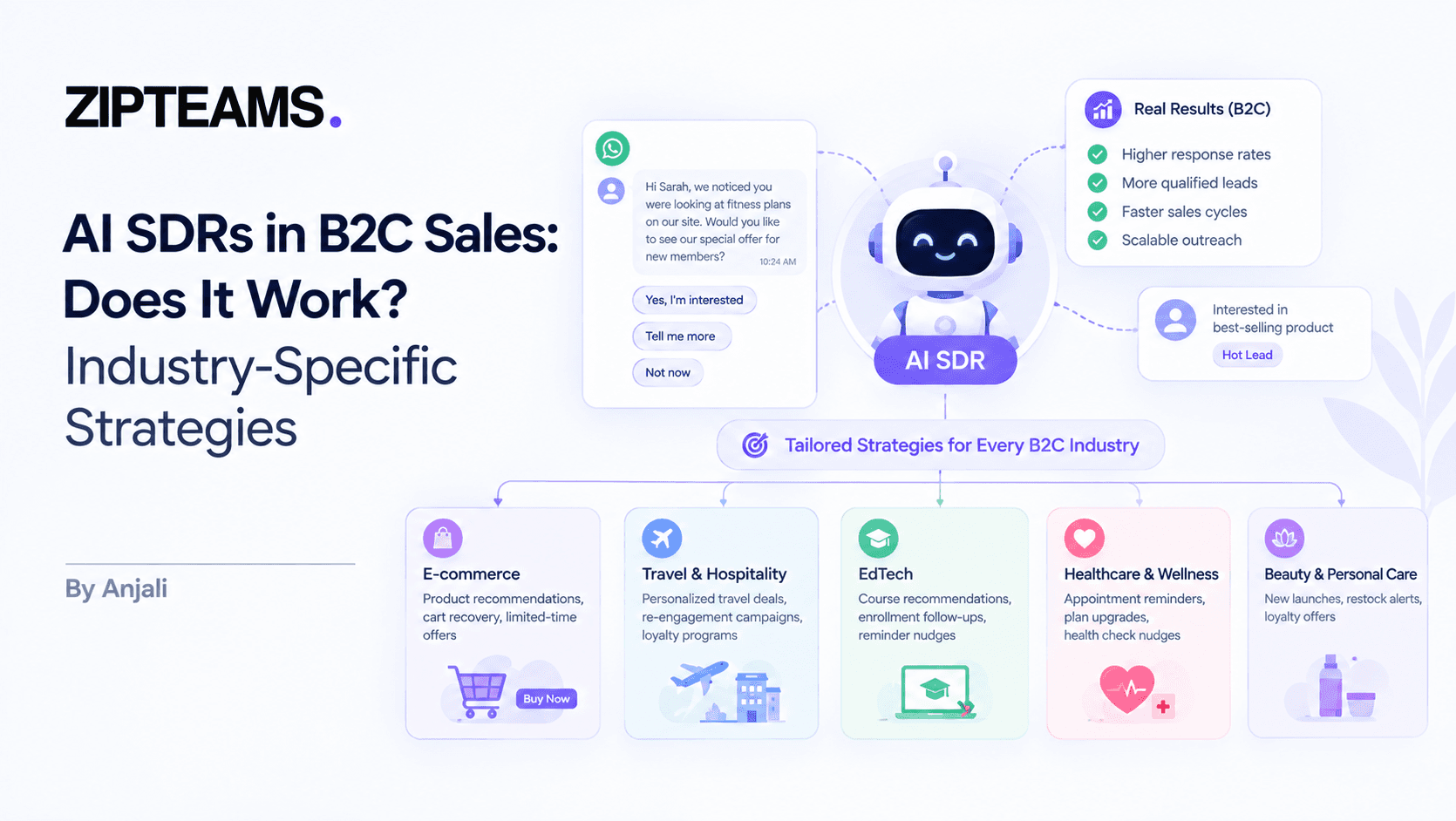
AI SDRs are usually discussed in the context of B2B sales.
That makes sense.
B2B sales teams have traditionally had SDRs researching accounts, contacting prospects, qualifying leads, following up, and booking meetings.
But many B2C businesses have the same operational problem—just at a much larger volume.
A real estate company may receive hundreds of property enquiries.
An education business may receive thousands of admission leads during an enrollment cycle.
An automotive dealership may receive enquiries about dozens of models.
A financial-services business may need to follow up with large numbers of applicants or product enquiries.
An e-commerce company may have customers asking product questions, abandoning carts, or returning to a purchase after an earlier interaction.
The challenge isn't always generating leads.
It is responding to, qualifying, and following up with enough of them quickly and consistently.
That is where AI SDRs can fit into B2C sales.
But B2C isn't simply B2B sales with more leads.
The buying journey is different.
The qualification criteria are different.
The channels are different.
And in industries such as financial services and healthcare, the risks of letting AI make the wrong decision can be much higher.
So, do AI SDRs work in B2C sales?
Yes—but the strongest use cases are not necessarily the ones that try to replace the entire sales process.
The better model is to use AI for high-volume conversations, qualification, follow-up, scheduling, and routing, while keeping humans responsible for decisions and interactions that require judgment, expertise, or sensitivity.
What Is an AI SDR in a B2C Context?
An AI SDR is an AI-powered sales agent that handles parts of the prospecting and early sales process.
In B2B, that might mean:
Research account → contact prospect → qualify → book meeting → hand off to AE.
In B2C, the workflow is often closer to:
Capture enquiry → respond instantly → understand requirement → qualify → recommend the next step → schedule → follow up → hand off when needed.
The important difference is that a B2C AI SDR often interacts with individual consumers rather than business accounts and buying committees.
That changes the information it needs.
Instead of asking:
"What is your company's annual revenue?"
it might need to understand:
What product or service the person wants
Their location
Their budget or stated range
Their preferred timing
Their eligibility
Their specific requirement
Their preferred appointment time
Whether another decision-maker is involved
What question is preventing them from moving forward
The AI's job is to collect enough useful context to determine the next appropriate action.
Why B2C Can Actually Be a Strong Use Case for AI SDRs
B2C sales often has three characteristics that make conversational AI useful:
High lead volume.
A business can receive hundreds or thousands of enquiries that humans cannot immediately contact.
Short response windows.
Consumers often compare several options simultaneously. Waiting hours for a response can mean losing the opportunity.
Repetitive qualification.
Many first conversations involve the same basic questions.
For example, a real estate team may repeatedly ask:
What's your budget?
Which location are you looking for?
When are you planning to buy?
Do you prefer 2BHK or 3BHK?
An education counsellor may repeatedly ask:
Which course are you interested in?
What is your current qualification?
When do you want to start?
Which entrance exam are you preparing for?
An AI SDR can handle these repetitive interactions while human salespeople focus on conversations that require more judgment.
This makes B2C AI SDRs particularly useful as a frontline qualification and follow-up layer.
Where B2C AI SDRs Are Different From B2B AI SDRs
The underlying technology can be similar.
The operating model isn't.
B2B AI SDRs often optimize for:
Account fit
Persona fit
Business need
Buying authority
Budget
Procurement timeline
Multi-stakeholder engagement
Meetings with sales representatives
B2C AI SDRs often optimize for:
Individual intent
Product or service fit
Eligibility
Location
Budget
Availability
Purchase timing
Appointment or visit
Consumer questions
Follow-up readiness
There is also usually less room for generic outreach.
A consumer asking about a specific product expects the AI to respond to that exact need.
The conversation is therefore often more transactional and immediate.
The Best B2C AI SDR Use Cases
Not every B2C sales process needs an AI SDR.
The strongest candidates usually have:
High inbound lead volume
Repetitive qualification
Multiple follow-up attempts
Time-sensitive enquiries
Clear qualification criteria
A defined human handoff
CRM or lead-management infrastructure
Enough conversation history to provide useful context
The weaker candidates are situations where every customer interaction requires highly specialized human judgment or where the AI would need to make consequential decisions that shouldn't be automated.
With that distinction in mind, here's how the model changes across industries.
Real Estate: Qualify the Enquiry Before the Salesperson Calls
Real estate is one of the clearest B2C applications for AI SDRs.
A property enquiry can arrive through:
Property portals
Website forms
Search ads
Social media
WhatsApp
Landing pages
Offline campaigns
The raw enquiry doesn't tell a salesperson enough.
A lead saying:
"Interested in 3BHK."
still leaves several unanswered questions.
The AI SDR can conversationally capture:
Preferred location
Property type
Budget range
Purchase timeline
Preferred configuration
Financing preference
Possession requirement
Site-visit interest
Real-estate AI agents are already being positioned around these exact workflows: qualification based on budget, location, and intent, followed by lead assignment and site-visit scheduling.
The workflow could look like:
New property enquiry
↓
AI responds immediately
↓
Understands property requirement
↓
Checks budget + location + timing
↓
Answers basic property questions
↓
Identifies buying intent
↓
Books site visit
↓
Hands qualified lead to property consultant
The human salesperson doesn't start with:
"So, what are you looking for?"
They start with:
"I saw you're looking for a 3BHK in Whitefield around ₹X–Y. I can show you the available options this weekend."
That's a much more informed handoff.
Real Estate Strategy: Don't Treat Every Lead the Same
A real estate AI SDR should adapt based on intent.
Consider three enquiries:
"Just browsing."
The AI should provide useful information and potentially nurture rather than immediately push for a site visit.
"We're looking to buy within two months."
This deserves higher priority.
"Can I visit the property tomorrow?"
This is an immediate scheduling opportunity.
The AI's value isn't simply asking questions.
It's recognizing what should happen next.
Education: Turn Enquiries Into Counselling-Ready Conversations
Education is another strong B2C use case because admissions generate large volumes of enquiries around specific periods.
Potential leads may come from:
Search campaigns
Meta ads
Website forms
WhatsApp
Webinars
Entrance-exam campaigns
College or course landing pages
An AI SDR can handle the initial conversation before a counsellor gets involved.
For example:
"I'm interested in MBA."
The AI can determine:
Which MBA program
Academic background
Graduation status
Preferred specialization
Admission cycle
Entrance exam status
Location preference
Budget or fee expectations
Whether the student or parent is driving the enquiry
Whether the person is ready to apply
Education-focused AI qualification workflows commonly use variables such as course interest, academic background, entrance-exam status, fee budget, intake cycle, and geography.
Education Strategy: Adapt to the Admission Stage
One of the biggest mistakes is treating every education lead as an immediate admission opportunity.
There is a huge difference between:
"I'm just exploring MBA programs."
and:
"I've already completed my application. What is the next step?"
The AI should identify the stage and change its behavior.
Exploring
→ Answer questions and nurture.
Considering
→ Explain relevant programs and qualification requirements.
Ready to apply
→ Guide toward the application or counselling step.
Application completed
→ Route to the appropriate admissions workflow.
The AI becomes a stage-aware admissions assistant, rather than simply a lead-follow-up bot.
Automotive: Match Intent to the Right Sales Action
Automotive sales is another useful B2C environment for AI SDRs.
A vehicle enquiry may include:
"Need a car under ₹15 lakh."
But a salesperson needs more information.
The AI can understand:
New or used vehicle
Preferred model
Budget
Fuel or powertrain preference
Location
Purchase timeline
Exchange requirement
Financing interest
Test-drive preference
The AI can then move the consumer toward the next action:
Product discovery → Qualification → Test drive → Dealership visit → Human sales conversation
Automotive AI workflows can also support model enquiries, test-drive booking, old-lead reactivation, and follow-up.
Automotive Strategy: Don't Over-Sell Before Understanding the Requirement
A consumer asking:
"What's the mileage of Model X?"
doesn't necessarily want a sales pitch.
A good AI SDR should answer the question first.
Then, if appropriate:
"Are you comparing it with another model?"
The conversation can gradually uncover intent rather than immediately forcing a booking.
That creates a better experience and gives the salesperson more useful context.
Financial Services: Qualification With Stronger Guardrails
Financial services can benefit from AI SDR-style workflows, but this is one of the areas where the distinction between qualification and decision-making matters most.
Potential use cases include:
Product enquiries
Loan enquiries
Insurance enquiries
Appointment scheduling
Document reminders
Application follow-up
Renewal reminders
Lead qualification
An AI could collect information such as:
Product interest
Employment type
Declared income range
Loan purpose
Preferred product
Application stage
But an AI SDR should not casually turn this information into an unauthorized financial decision or recommendation.
Industry workflows increasingly distinguish conversational qualification from consequential decisions, and responsible implementations recommend human review where eligibility or other sensitive outcomes are involved.
Financial Services Strategy: Use AI for Intake, Not Uncontrolled Decisions
A safer pattern is:
Enquiry
↓
AI collects permitted information
↓
AI identifies the appropriate product or workflow
↓
AI routes the lead
↓
Human or approved system performs the consequential decision
This keeps AI useful without giving it unrestricted authority over sensitive financial outcomes.
Healthcare: Intake and Routing Before Sales
Healthcare requires an even clearer distinction between sales assistance and clinical decision-making.
Potential AI SDR-style use cases can include:
Appointment enquiries
Service information
Clinic location
Specialist availability
Appointment scheduling
Insurance information collection
Follow-up on non-clinical enquiries
The AI can help determine:
"What type of appointment are you trying to book?"
But it should not casually turn a sales agent into a medical decision-maker.
Healthcare AI qualification examples commonly focus on intake, urgency classification, insurance information, specialist routing, and appointment scheduling, with appropriate human escalation.
Healthcare Strategy: Define the Boundary Clearly
The AI should know:
What it can answer
What it can collect
What it can schedule
What requires a human
What it must never infer or decide
That boundary should be part of the agent's guardrails—not something discovered after deployment.
E-Commerce: AI SDRs Become Shopping Assistants
E-commerce is where the term "AI SDR" becomes less obvious.
A traditional SDR is selling.
An e-commerce AI agent may instead help the customer make a purchase.
The workflow can include:
Product discovery
Product questions
Recommendation
Comparison
Cart recovery
COD verification
Purchase follow-up
Repeat-purchase campaigns
For example:
"I need running shoes for daily use under ₹5,000."
Instead of sending a generic product catalogue, the AI can ask:
"Do you prefer more cushioning or a lightweight shoe?"
That creates a conversational product-discovery experience.
Current B2C AI-sales workflows are already being applied to product questions, cart recovery, purchase support, and COD verification.
E-Commerce Strategy: Optimize for Purchase Friction
The AI's goal isn't necessarily to book a meeting.
It might be to remove the reason the customer hasn't purchased.
That could mean:
Question → Answer
Uncertainty → Recommendation
Comparison → Clarification
Cart abandonment → Reminder
Delivery concern → Information
Purchase intent → Checkout
This is a useful reminder that an AI SDR framework should be adapted to the actual conversion event.
Travel, Hospitality, and Experiences
Travel and hospitality businesses have another high-volume conversational sales workflow.
A customer may ask:
"Looking for a weekend trip for four people."
The AI can capture:
Destination
Dates
Number of travelers
Budget
Accommodation preference
Activities
Transport requirements
Then it can:
Recommend suitable options
Answer questions
Check availability through connected systems
Capture preferences
Move the customer toward booking
Hand off complex requests
The same principle applies to events, tours, hotels, and experiences:
Turn an unstructured enquiry into a structured buying conversation.
Home Services: Qualify the Job, Not the Person
For home services, qualification is usually about the job requirement.
A consumer might say:
"My AC isn't cooling."
The AI can determine:
Service type
Location
Urgency
Appliance type
Preferred appointment time
The objective isn't to score the person as a "hot lead."
It's to determine:
What service is required, how urgent is it, and what should happen next?
This is an important B2C principle:
Qualification should be designed around the purchase journey, not copied from a B2B lead-scoring framework.
The B2C AI SDR Shouldn't Ask 10 Questions Up Front
One of the easiest ways to make a B2C AI SDR feel robotic is to turn qualification into a questionnaire.
Imagine:
What's your budget?
What's your location?
What's your preferred product?
What's your timeline?
What's your age?
What's your occupation?
What's your preferred appointment time?
That feels like a form wearing a chatbot interface.
Instead, the AI should extract information from natural conversation.
If a customer says:
"I'm looking for a 2BHK in Whitefield around ₹1.2 crore and want to move in next year."
The AI already knows:
Property type
Location
Budget
Approximate timeline
It shouldn't ask those questions again.
The next question should fill an actual information gap.
Use Progressive Qualification
A strong B2C AI SDR can qualify progressively.
Stage 1: Understand the request
What does the customer want?
Stage 2: Identify important constraints
Budget, location, eligibility, timing, availability, etc.
Stage 3: Detect intent
Is this research, consideration, or immediate purchase intent?
Stage 4: Determine next action
Answer, recommend, schedule, nurture, or hand off.
This creates a more natural conversation than a fixed qualification script.
Speed Matters, But Speed Alone Isn't the Goal
AI SDRs are attractive in B2C partly because they can respond immediately.
But the objective isn't:
Respond instantly with anything.
It is:
Respond quickly with something useful.
A fast but irrelevant response can still lose the customer.
The ideal first response should combine:
Speed + context + relevance + next action
For example:
"Yes, we have 2BHK options in Whitefield. If you're targeting around ₹1.2 crore and planning to move next year, I can narrow down the options and help arrange a visit."
That is much more useful than:
"Thanks for your enquiry! Our team will contact you shortly."
B2C AI SDRs Need More Channel Flexibility
B2B AI SDR workflows often revolve heavily around email and professional outreach.
B2C conversations can happen across:
Website chat
WhatsApp
SMS
Phone
Social messaging
Email
Mobile apps
The channel can influence how the AI should communicate.
A long email may be appropriate in one context.
A WhatsApp conversation usually needs shorter, more conversational responses.
A voice conversation needs an entirely different interaction pattern.
The underlying context should remain consistent even when the channel changes.
Build One Customer Context Across Channels
Imagine a customer first asks on WhatsApp:
"Looking for a 3BHK under ₹2 crore."
Then visits the website.
Then receives a call.
The sales team shouldn't have to start from zero every time.
The AI system should ideally preserve useful context such as:
Requirement
Budget
Location
Timing
Previous questions
Objections
Actions already taken
That turns individual interactions into one continuous customer journey.
B2C Personalization Is About Intent, Not Just Demographics
Personalization often gets reduced to:
Name + location + product.
That's not enough.
Two customers with the same demographic profile can have completely different intent.
Consider:
Customer A:
"Just researching."
Customer B:
"I need to purchase this week."
Both may be 30-year-old customers from the same city.
Their conversations should be completely different.
A good B2C AI SDR therefore personalizes around:
Intent
Timing
Need
Preferences
Previous interactions
Constraints
Questions
rather than demographic information alone.
Follow-Up Is Where B2C AI SDRs Can Create Significant Leverage
Many B2C leads don't convert during the first interaction.
They may say:
"I'll think about it."
"I'll discuss it with my parents."
"I'll check my budget."
"Call me next month."
This doesn't necessarily mean "lost."
It means the next action should change.
The AI can record:
Reason for delay → Expected timing → Relevant context → Follow-up date
Then return to the conversation at an appropriate time.
This is much better than sending:
"Just following up."
A contextual follow-up might be:
"You mentioned you were comparing two MBA programs before deciding. Have you narrowed down your options?"
The AI remembers why the customer wasn't ready.
B2C AI SDRs Should Be Designed Around Events
A traditional sales sequence might say:
Day 1 → Message
Day 3 → Message
Day 7 → Message
B2C journeys often work better around events.
For example:
New enquiry
→ Immediate response
Product viewed
→ Relevant information
Question answered
→ Next recommendation
High purchase intent
→ Checkout or appointment
Customer goes silent
→ Contextual follow-up
Customer says "next month"
→ Future follow-up
Appointment booked
→ Reminder
This turns the AI SDR into an event-driven sales agent.
The Human Handoff Is Still Critical
The goal of an AI SDR isn't to keep the AI involved forever.
The goal is to know when the human should enter.
Good handoff triggers might include:
High purchase intent
Complex objection
High-value customer
Request for human assistance
Sensitive question
Negotiation
Exception to standard policy
Complaint
Unusual request
The AI should pass the conversation context with the handoff.
For example:
Customer: Priya
Requirement: 3BHK in Whitefield
Budget: ₹1.5–2 crore
Timeline: 2–3 months
Intent: High
Concern: Wants clarity on possession date
Next step: Requested site visit Saturday
That's far more useful than:
"Please call Priya."
Don't Let the AI Make Consequential B2C Decisions Without Guardrails
B2C sales often touches sensitive information.
Examples include:
Financial eligibility
Health-related information
Identity
Insurance
Credit
Education eligibility
Personal circumstances
An AI SDR should not automatically become the final decision-maker simply because it can collect the information.
A better architecture is:
AI gathers context
→ AI explains permitted information
→ AI routes or recommends the next workflow
→ Approved system or human makes consequential decision
This distinction becomes especially important as AI agents become more autonomous.
Measure B2C AI SDRs Differently From B2B AI SDRs
The usual B2B metrics aren't always enough.
A B2C AI SDR might not be trying to book a sales meeting.
The relevant conversion could be:
Qualified lead
Site visit
Test drive
Counselling session
Application
Purchase
Appointment
Booking
Checkout
Human-assisted conversion
Track the full journey.
A useful measurement framework is:
Conversation quality
→ Did the AI understand the customer?
Qualification quality
→ Did it collect the right information?
Routing quality
→ Did the right person or workflow receive the lead?
Conversion quality
→ Did the customer take the intended next action?
Revenue quality
→ Did that action produce a meaningful business outcome?
Don't Optimize for Lead Volume Alone
An AI SDR can make a funnel look healthier by increasing:
Conversations
Responses
Qualified leads
Appointments
But if those leads aren't actually useful, the business hasn't improved.
For example:
1,000 AI-qualified leads
sounds impressive.
But:
1,000 leads → 400 human-accepted → 120 appointments → 40 purchases
tells you much more.
The most useful KPI is therefore usually downstream conversion, not AI activity.
A Practical B2C AI SDR Framework
Before deploying an AI SDR, define five things.
1. Customer
Who is the AI talking to?
2. Intent
What customer behavior should the AI identify?
3. Qualification
What information is actually needed?
4. Action
What should happen next?
5. Boundary
When must the AI stop and involve a human?
For example:
Real estate
Customer → Property enquiry
Intent → Ready to buy within 3 months
Qualification → Budget + location + property type + timeline
Action → Book site visit
Boundary → Negotiation or complex financial question
This framework can then be adapted to different industries.
A B2C AI SDR Implementation Process
Start with one journey, not the entire sales funnel.
For example:
Meta lead → AI qualification → counselling appointment
or:
Property enquiry → AI qualification → site visit
or:
Vehicle enquiry → AI qualification → test drive
Then define:
Step 1: Entry trigger
What causes the AI to start?
Step 2: Context
What does it already know?
Step 3: Conversation
What does it need to learn?
Step 4: Qualification
What makes the lead actionable?
Step 5: Next action
What should happen automatically?
Step 6: Human escalation
What requires a salesperson?
Step 7: Measurement
How will you know it worked?
This is much safer than launching an AI agent with a vague goal like:
"Talk to all our leads."
The Biggest Mistakes in B2C AI SDR Deployment
Treating B2C Like B2B
Don't copy a B2B qualification framework directly.
B2C qualification should reflect the actual customer journey.
Asking too many questions
The AI should collect only information that changes the next action.
Optimizing for meetings
The conversion event may be a site visit, test drive, application, appointment, booking, or purchase.
Ignoring existing context
If the customer already gave the information, don't ask again.
Treating every lead equally
A high-intent buyer and someone casually browsing shouldn't receive identical treatment.
Giving the AI unlimited authority
Define what the AI can say, collect, decide, and execute.
Forgetting the human handoff
The AI should make human salespeople more effective, not create another inbox they have to decode.
Does an AI SDR Actually Work for B2C Sales?
The answer depends less on whether the company is B2C and more on the structure of the sales journey.
AI SDRs are a stronger fit when:
Lead volume is high
Response speed matters
Qualification is repetitive
The buying journey has clear stages
Follow-up is currently inconsistent
Customer questions are predictable
There is a clear handoff point
Outcomes can be measured
They are a weaker fit when:
Every interaction requires specialist judgment
Qualification criteria are unclear
The business has little usable customer context
The AI would need to make sensitive decisions
There is no defined human escalation path
So the real question isn't:
"Can an AI SDR sell to consumers?"
It is:
"Which parts of the consumer sales journey can AI handle reliably?"
That is the question businesses should answer before deployment.
The Future of B2C AI SDRs Is Conversational
The traditional B2C funnel looks something like:
Ad → Form → Lead → Call → Follow-up → Purchase
AI SDRs can turn it into:
Intent → Conversation → Qualification → Personalization → Action
The form captures data.
The conversation captures context.
That distinction matters.
A form might tell a business:
Course: MBA
City: Bengaluru
A conversation might reveal:
"I'm comparing MBA programs because I want to switch careers next year, but I'm unsure whether I should take the weekend or full-time program."
The second dataset is far more useful for deciding what should happen next.
That is where AI SDRs can have the biggest impact in B2C.
Final Takeaway
AI SDRs can work in B2C sales, but the winning model isn't simply automate every sales conversation.
The strongest use cases are usually the repetitive, high-volume parts of the journey:
Respond → Understand → Qualify → Follow up → Schedule → Route → Handoff
The exact workflow should then change by industry.
Real estate needs property and site-visit qualification.
Education needs course, eligibility, and admission-stage context.
Automotive needs vehicle preference and test-drive intent.
Financial services needs stronger controls around sensitive information and decisions.
Healthcare needs clear boundaries between administrative intake and clinical judgment.
E-commerce needs product discovery and purchase assistance.
The common principle is simple:
Use AI to handle conversational work at scale, but give it enough context to be useful and enough guardrails to know when a human should take over.
That is what makes an AI SDR useful in B2C—not simply the ability to send more messages, but the ability to turn high-volume consumer enquiries into context-rich, actionable sales conversations.